
What a 1007 rent schedule does in DSCR underwriting Form 1007, formally the Single Family…
Can You Finance 100% of Rehab Costs on a Flip Loan?

Can You Really Finance 100% of Rehab Costs on a Flip Loan?
Short answer: yes, some lenders will fund the entire renovation budget — but that is not the same thing as buying a property with no cash at all.
This is the question most flippers actually care about. You’ve found a distressed house, priced the scope of work, and you want to know how much of that renovation you can push onto the loan instead of your own reserves. The confusion starts when marketing language collapses three different numbers into one. Financing 100% of rehab costs means the lender advances the full construction budget, usually through reimbursement draws. Financing 100% of the purchase price is a separate question. And financing 100% of the after-repair value (ARV) is not something reputable lenders do at all.
Three terms control the answer on nearly every fix and flip loan: how rehab dollars are advanced, loan-to-cost (LTC), and ARV. LTC measures the loan against your total project cost — purchase plus renovation. ARV caps the loan against the finished value. Both apply at the same time, and the lower of the two wins.
Even in a full-rehab-funding structure, expect to bring cash for closing costs, reserves, and sometimes interest carry between draws. What follows walks through the lender caps, experience thresholds, and deal quality that decide whether you qualify — not the headline numbers on a rate sheet.
Rehab Financing, LTC, and ARV Explained in Plain English
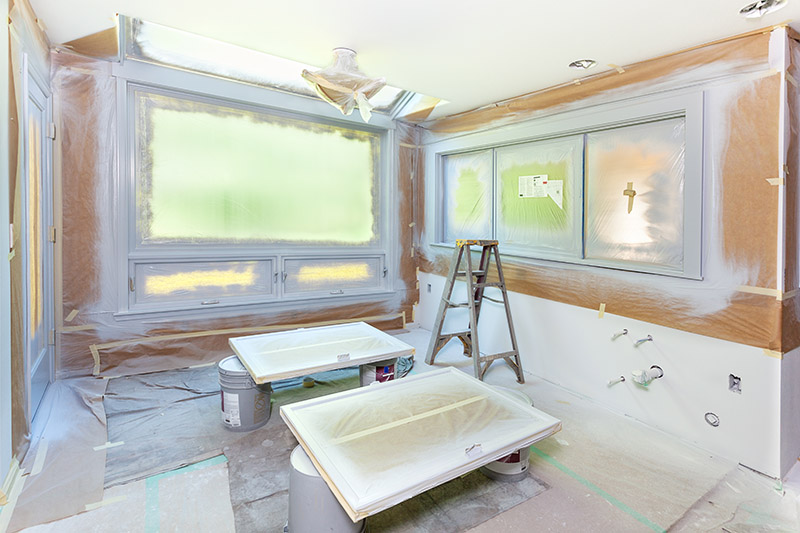
Before any math makes sense, three terms need to be separated.
Rehab financing is the slice of your renovation budget the lender agrees to fund. It is almost never handed over at closing. Instead, the lender holds the rehab money and releases it in draws — you pay for a phase of work, an inspector or desktop review confirms it is done, and the lender reimburses you. That timing matters: even a fully funded rehab budget means you float each stage of work before you get paid back.
Loan-to-cost (LTC) compares the loan to the total project cost — purchase price plus rehab, and often soft costs, closing costs, and contingency. It measures how much of the actual cash the deal consumes that the lender is covering.
After-repair value (ARV) is the lender’s estimate of what the finished property will appraise for. Loan divided by ARV (sometimes written LTARV) measures exit cushion: how much room exists if the resale comes in soft.
The two caps work in different directions. LTC limits leverage against what you spend; ARV limits leverage against what the property will be worth. Lenders underwrite both and fund whichever bites first. A 2026 guide to LTV, LTC, and ARV puts indicative bridge and renovation ranges at roughly 75%–85% LTC and 60%–75% of ARV, with each lender setting its own caps by property type, market, and track record.
That is why “100% of rehab costs” and “100% financing” are not the same promise. A lender can fund every rehab dollar and still stop short of full project cost. Rehab Financial Group’s program, described in a Private Lender Link interview, covers purchase and rehab but caps total financing at 65%–75% of ARV depending on credit and experience — so with fix and flip loans, the ARV ceiling usually decides the real number.
When 100% Rehab Funding Is Possible, and What Lenders Still Require
Full rehab funding is real, but the phrase is narrower than the marketing suggests. What lenders mean is that they advance 100% of the approved renovation budget — not 100% of the deal, and not 100% of the property’s value. Loan size is still set as the lesser of two caps: a share of total project cost and a share of after-repair value (ARV). Programs that advertise complete rehab coverage commonly hold total exposure to roughly 65%–75% of ARV, so a thin spread between purchase price and ARV shrinks the loan regardless of how the renovation is funded.
Three conditions show up again and again in fix and flip loans structured this way:
- Track record. Three or more completed projects is the benchmark most often quoted. A Rehab Financial Group program overview published by Private Lender Link defines an experienced borrower as someone with 3+ completed projects, with a 650 minimum FICO and better ARV leverage above 700. Thresholds vary by lender, so confirm the definition before you underwrite the deal around it.
- A short, credible exit. These programs are built for 9–12 month timelines with a sale or refinance identified up front.
- A conventional residential scope. Standard cosmetic-to-moderate rehabs qualify; teardown rebuilds and severely damaged structures generally do not.
Even with the renovation fully covered, cash does not disappear. Borrowers typically fund closing costs, an interest reserve (or, in some programs, monthly payments starting immediately), insurance and permits, and any gap created when the ARV cap — not the cost cap — becomes the binding limit. Lenders also want liquidity held outside the deal; one published program requires 25% of the rehab budget plus closing costs, or a $15,000 minimum plus closing costs.
Then there is timing. Rehab money moves in draws, reimbursed after the work is completed and inspected. That means you pay the first crew and the first material order out of working capital, then get repaid.
How LTC and ARV Cap Loan Size on a Sample Flip Deal
Loan-to-cost (LTC) measures the loan against your total project cost — purchase price plus rehab budget. Loan-to-value here is usually expressed against the after-repair value (ARV), the appraised price once the work is done. Lenders apply both, then fund the lower of the two numbers. That single rule explains why a fully funded rehab budget still doesn’t mean unlimited leverage.
Take a concrete deal:
- Purchase price: $200,000
- Rehab budget: $60,000
- Total project cost: $260,000
- Projected after-repair value: $325,000
Step 1 — the LTC cap. At 90% LTC, a common ceiling on fix and flip loans for repeat borrowers, the maximum loan is $234,000. At a full 100% LTC, the math allows $260,000.
Step 2 — the ARV cap. Lender programs that advertise 100% loan-to-cost almost always pair it with a 70%–75% ARV ceiling. On this deal:
| ARV ceiling | Maximum loan | Rehab covered | Cash toward purchase price |
|---|---|---|---|
| 70% of $325,000 | $227,500 | $60,000 in full | $32,500 |
| 75% of $325,000 | $243,750 | $60,000 in full | $16,250 |
Step 3 — which cap wins. At a 70% ARV ceiling, $227,500 is less than either LTC figure, so the appraisal controls. The lender can still reimburse every dollar of the $60,000 rehab budget through construction draws and apply the remaining $167,500 to the purchase — leaving you to cover $32,500 of the purchase price out of pocket. Raise the ARV ceiling to 75% and that gap narrows to $16,250. Raise the projected value to $375,000 and 70% ARV becomes $262,500, at which point the 90% LTC cap of $234,000 becomes the binding constraint instead.
None of those figures include closing costs, lender points, title and appraisal fees, or an interest reserve to carry monthly payments until resale. Draws are also reimbursements: you pay the contractor, request an inspection, then get funded, so each phase of the renovation needs float.
Run the two caps side by side before you write the offer. A deal that pencils at 90% LTC can stall on a conservative appraisal, and the difference between a $16,250 and a $32,500 cash requirement often decides whether the project is feasible at all.
What Typical Fix and Flip Lenders Offer on LTC, ARV, and Rehab Funding
Rehab funding sits on a spectrum. At one end, a handful of programs advertise the full renovation budget: Flipside Loans publishes up to 90% of loan-to-cost (LTC) and up to 100% of rehab costs for experienced borrowers, and Rehab Financial Group markets up to 100% of purchase and rehab costs for qualifying borrowers alongside a 75% after-repair value (ARV) ceiling. At the other end, plenty of lenders fund 80% to 90% of the renovation budget and expect the investor to carry the rest.
The pattern behind those headlines is consistent. Where the rehab is fully funded, the ARV cap usually lands in the low-to-mid 70% range — the plain-English breakdown of no-down-payment flip financing from Axiant Partners puts that ceiling around 70% to 75% and notes that “100%” almost always means 100% of cost, not 100% of value. Higher LTC on an experienced-operator deal doesn’t remove that limit; the two caps work together, and whichever binds first sets your loan amount.
Sizing also moves with the file, not just the program sheet. Track record, property type, and how credible your exit looks inside a 12-month window all shift terms, which is why the same duplex can be underwritten three different ways by three lenders.
So when comparing fix and flip loans, treat the advertised percentage as a starting point and ask the more useful question: after the draw schedule, interest reserve, and closing costs, how much cash leaves your account at the table?
FAQ: The Two Questions Borrowers Ask First
Can a flip loan cover 100% of the rehab budget?
Yes — but only in specific structures, and it almost never means the whole project is funded. The rehab portion is the part lenders are most willing to finance in full, because they release it in draws after work is inspected and completed. The purchase side is usually where your cash goes. Programs advertising full rehab funding typically ask for a track record: Private Lender Link’s overview of 100% financing for rehab projects notes that around three or more completed flips is a common threshold, and that these programs are generally aimed at residential rehabs with a clear resale exit inside 12 months. Even with rehab fully covered, plan on cash for closing costs, an interest reserve, and any gap between the purchase price and what the lender will advance on it. Axiant Partners’ breakdown of no-down-payment flip loans makes the same point: “100%” almost always describes loan-to-cost, not loan-to-value.
What loan-to-cost and after-repair-value limits do lenders actually offer?
Most fix and flip loans are quoted with two ceilings, and the smaller one wins. Loan-to-cost (LTC) is measured against purchase price plus renovation budget — commonly in the 85%–90% range, with some programs reaching 100% of the rehab line for qualified borrowers. After-repair value (ARV) is the second cap, and it usually lands near 70%–75% of the finished value. If your deal pencils at 100% LTC but the ARV test caps the loan lower, the ARV number sets your loan amount and you bring the difference.
The practical takeaway: ask any lender for both numbers, the draw schedule, and a written estimate of cash due at closing before you write a non-contingent offer. Aspire Mortgage can walk through those figures on a specific property.

